Best Document Parsing Tools for Logistics and Supply Chain Teams in 2026
Freight invoices, bills of lading, packing lists, delivery notes — logistics teams deal with documents in dozens of formats. Here are the best parsing tools for supply chain and logistics operations in 2026.

TL;DR
- Logistics teams deal with freight invoices, bills of lading, packing lists, delivery notes, and customs documents — all in different formats from different sources.
- The best parsing tool for most logistics SMBs is Parsio: no-code setup, four parser engines, and direct exports to spreadsheets and automation tools.
- Docsumo suits high-volume enterprise teams with dedicated logistics AI models.
- Affinda is purpose-built for freight forwarders extracting BOL and freight invoice data at scale.
- Veryfi handles real-time mobile capture of receipts, freight receipts, and customs documents.
- Klippa DocHorizon covers international compliance and multi-language logistics documents.
- Match the tool to your document mix: stable formats → template parser; standard invoices → AI parser; variable layouts → GPT parser.
The best document parsing tools for logistics and supply chain teams in 2026 are Parsio, Docsumo, Affinda, Veryfi, and Klippa DocHorizon — each suited to a different combination of document types, team size, and workflow complexity. For most SMBs and operations teams that need fast, no-code setup and flexible multi-format support, Parsio is the strongest starting point. Larger teams processing thousands of bills of lading or freight invoices per month may prefer Docsumo or Affinda for their purpose-built logistics models.
Logistics document processing is one of the most document-intensive workflows in any business. A mid-size freight forwarder handling 500 shipments per month typically processes between 2,500 and 5,000 individual document pages — freight invoices, bills of lading, packing lists, customs declarations, delivery notes, and certificates of origin — often arriving from dozens of carriers and suppliers in different formats, languages, and layouts. Manual data entry across this volume introduces errors, slows shipments, and ties up operations staff in repetitive work that automation can handle reliably.
This guide covers five of the best tools available for logistics document parsing, what each one does well, and how to decide which fits your team's workflow.
What to Look for in a Logistics Document Parsing Tool
Logistics operations differ from standard accounts payable or finance workflows in one important way: the document formats are wildly inconsistent. A freight invoice from FedEx Freight looks nothing like one from a regional carrier. Bills of lading from different shipping lines use different field layouts, date formats, and cargo codes. The right parsing tool needs to handle this variability without requiring a separate template for every sender.
Evaluate any logistics document parsing tool against these criteria:
- Document type coverage: Does the tool handle your specific mix — freight invoices, BOLs, packing lists, delivery notes, customs forms?
- Layout flexibility: Can it extract data from variable-format documents without a custom template per sender?
- Ingestion options: Can documents arrive by email attachment, upload, API, or automation platform?
- Export destinations: Does extracted data flow into your TMS, ERP, spreadsheet, or automation workflow directly?
- Setup complexity: Does your team have the technical resources to configure the tool, or do you need a no-code option?
- Accuracy on low-quality scans: Logistics documents are often photos of physical paperwork — OCR quality matters.
1. Parsio — Best for SMBs and Operations Teams That Need No-Code Multi-Format Parsing
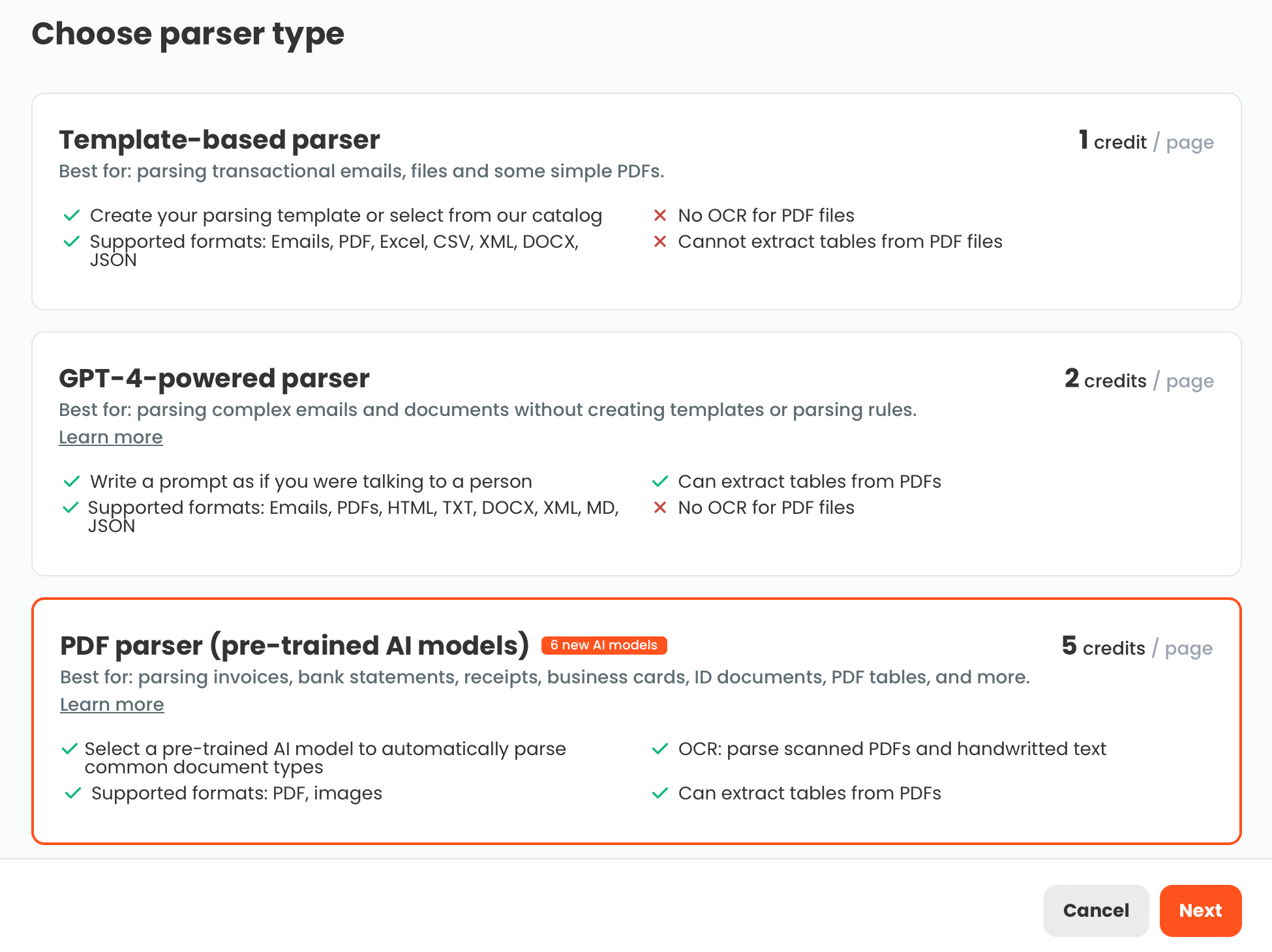
Parsio is a document parsing platform that extracts structured data from emails, PDFs, and images using four parser types: a template-based parser for stable formats, a pre-trained AI parser for specific document categories, a GPT-powered parser for variable or complex layouts, and an OCR converter for plain-text extraction from scanned files. This multi-engine approach makes it especially useful for logistics teams whose document mix includes both high-volume stable formats and one-off irregular documents from new suppliers or carriers.
What Parsio handles well for logistics teams:
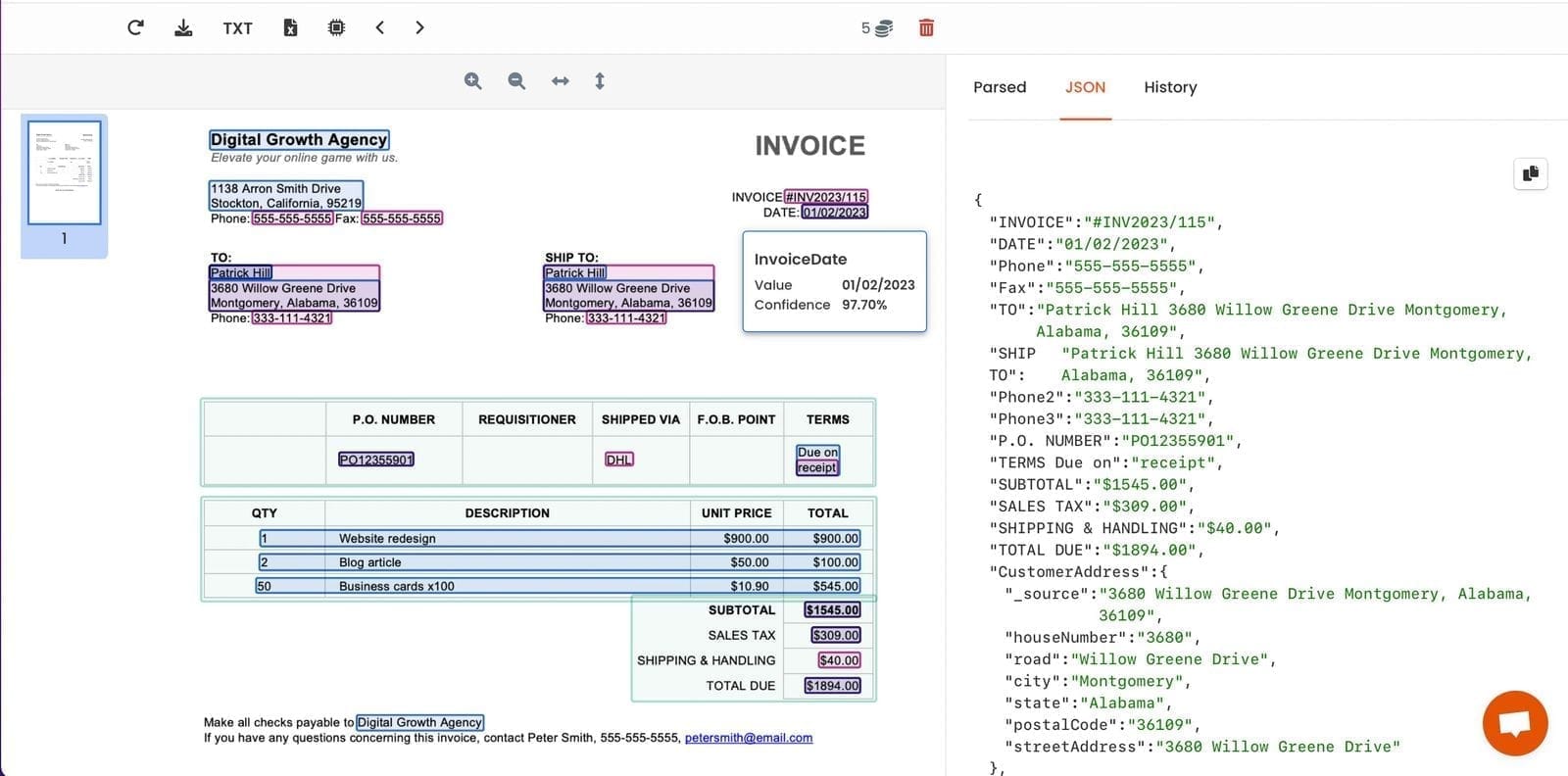
- Freight invoices: Parsio's pre-trained AI model handles standard freight invoices without any template setup, extracting vendor, amount, line items, and reference numbers automatically. See the full workflow in the guide to automating freight invoice data extraction.
- Bills of lading: BOL formats vary by carrier and shipping line. Parsio's GPT-powered parser handles variable-layout BOLs by understanding field meaning rather than position, so it adapts to new senders without a new template. Read more in the bill of lading extraction guide.
- Packing lists: Table-heavy packing lists with variable column names are handled by the GPT parser, which can extract line-item rows into structured fields. See the packing list extraction walkthrough.
- Delivery notes: Standard delivery confirmation documents are extracted using the AI or GPT parser depending on format consistency. The delivery note extraction guide covers this in detail.
- Shipping notification emails: Parsio's template-based parser is ideal for machine-generated shipping confirmation emails from carriers like FedEx, UPS, and DHL, where the format is consistent and predictable.
An important Parsio advantage for teams dealing with many different document types is that the GPT parser prompt can be auto-generated from a sample document you upload — you do not need to write the extraction prompt manually. This dramatically reduces setup time when onboarding a new carrier, supplier, or document format.
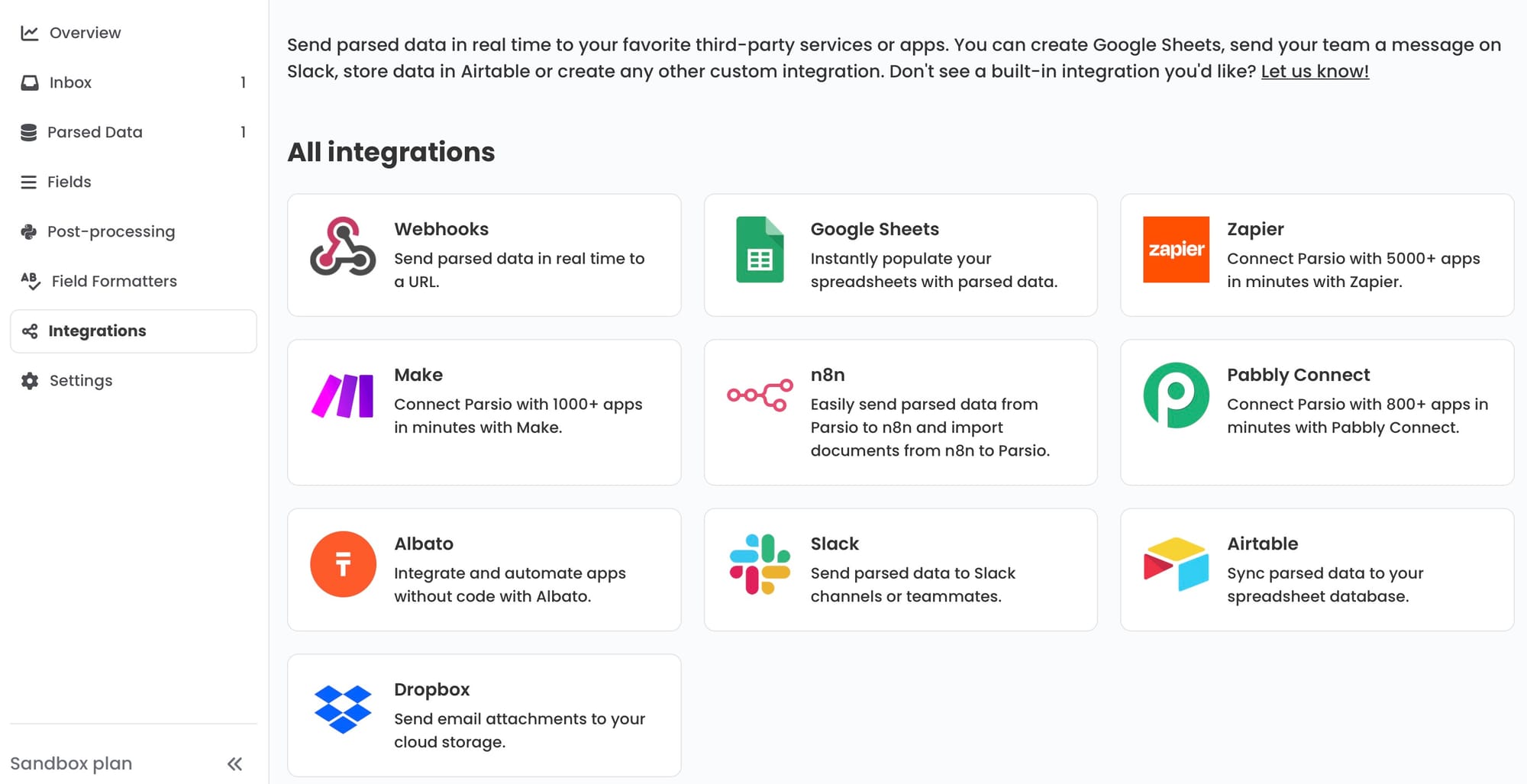
Parsed data exports directly to Google Sheets, webhooks, CSV, Excel, or automation platforms including Zapier, Make, and n8n — which means logistics teams can route extracted freight invoice totals or shipment reference numbers directly into their TMS, ERP, or finance tool without building a custom integration from scratch.
Best for: SMBs and operations teams processing logistics documents across multiple formats, carriers, and suppliers — especially teams that need fast no-code setup and flexible exports to downstream tools.
Limitations: Parsio is optimized for structured and semi-structured business documents rather than highly complex multi-page technical specifications or long unstructured reports above 10 pages.
2. Docsumo — Best for Enterprise Teams with High-Volume Logistics Document Processing
Docsumo is an enterprise intelligent document processing platform with dedicated pre-trained AI models for logistics use cases including bills of lading, shipment tracking documents, and freight invoices. It handles document classification automatically — sorting incoming documents by type before extraction — and supports human-in-the-loop review queues for exception handling when confidence scores fall below a threshold.
Docsumo is designed for teams processing thousands of logistics documents per day with strict accuracy requirements. It integrates with ERPs and TMS systems through its API and supports webhook delivery of extracted data. Its logistics models have been trained on large corpora of carrier-specific documents and handle most BOL and freight invoice layouts without custom configuration.
Best for: Enterprise logistics operations teams, freight forwarders, and 3PLs processing high volumes of standardized logistics documents with existing ERP or TMS integrations.
Limitations: Higher cost and longer implementation time than no-code tools. Requires developer resources for API integration and workflow configuration. Overkill for teams processing a few hundred documents per month.
3. Affinda — Best for Freight Forwarders Needing Purpose-Built Logistics Extraction
Affinda is an AI document parsing platform with a dedicated logistics offering. It classifies and extracts data from freight invoices, delivery orders, bills of lading, and proof-of-delivery documents as they arrive, pulling fields like container numbers, charges, customs codes, and proof-of-delivery signatures. Affinda is specifically positioned for the freight forwarding use case and supports bulk document processing through its API.
Its key differentiator is the combination of automatic document classification with field-level extraction trained specifically on freight and logistics document types. This means a mixed batch of incoming freight documents — some invoices, some BOLs, some packing lists — can be processed without pre-sorting by document type.
Best for: Freight forwarders and logistics-first businesses that process large volumes of cargo documents and need document classification built into the extraction pipeline.
Limitations: Less general-purpose than Parsio. Teams with a wider document mix beyond freight-specific formats may find its scope limiting. API-first setup requires development resources.
4. Veryfi — Best for Real-Time Mobile Capture of Field Logistics Documents
Veryfi is an OCR and document extraction platform designed for real-time processing, with particular strengths in mobile-first document capture. It includes a logistics and freight module that handles customs documents, freight invoices, bills of lading, and proof-of-delivery receipts. Veryfi's mobile SDK allows field teams to photograph physical logistics paperwork — a delivery receipt, a signed BOL, a paper invoice — and receive structured data back within seconds.
Veryfi is one of the strongest options when the physical document capture step matters: when drivers, warehouse staff, or field operations teams are the source of the document rather than a supplier email or carrier portal. It supports bulk API processing as well as mobile capture, and offers pre-built integrations with accounting and logistics platforms.
Best for: Logistics teams that need fast mobile capture of physical documents in the field — delivery drivers, warehouse teams, or operations staff handling paper-based freight receipts, signed BOLs, and proof-of-delivery documents.
Limitations: Higher API pricing at scale. Less suited to teams whose document workflow is fully digital (email-based or portal-based) rather than physical capture.
5. Klippa DocHorizon — Best for International Logistics with Multi-Language and Compliance Needs
Klippa DocHorizon is an IDP platform with a strong international focus, supporting document extraction across many languages and compliance requirements for cross-border trade documentation. It handles commercial invoices, customs declarations, packing lists, and carrier documents in multiple languages and currencies, with built-in validation and fraud detection features.
For logistics teams operating across multiple countries — import/export teams, customs brokers, or global procurement departments — Klippa DocHorizon's multi-language capability and compliance tooling add meaningful value beyond what a single-language parser can offer. It supports API access, webhook delivery, and pre-built integrations.
Best for: International logistics, import/export, and customs brokerage teams that process documents in multiple languages or need compliance-grade extraction with audit trails and fraud detection.
Limitations: Enterprise pricing. More setup required than no-code alternatives. Not optimized for teams dealing primarily with domestic single-language document workflows.
Quick Comparison: Logistics Document Parsing Tools at a Glance
| Tool | Best For | Setup | Key Strength |
|---|---|---|---|
| Parsio | SMBs, ops teams, mixed document types | No-code | 4 parser engines; auto-generates GPT prompt from sample doc |
| Docsumo | Enterprise logistics teams, high volume | API + configuration | Pre-trained logistics models + human-in-loop review |
| Affinda | Freight forwarders, cargo document workflows | API | Auto-classification + freight-specific extraction |
| Veryfi | Field teams, mobile capture of physical docs | Mobile SDK + API | Real-time OCR on photographed documents |
| Klippa DocHorizon | International/cross-border logistics | API + configuration | Multi-language support, compliance and fraud detection |
How to Choose the Right Tool for Your Logistics Team
The right logistics document parsing tool depends on three factors: your document mix, your technical resources, and where the extracted data needs to go.
If your team is an SMB or mid-market operation without a dedicated engineering team: Start with Parsio. It requires no custom development to set up. For standard freight invoices and delivery notes, the pre-trained AI parser works immediately. For bills of lading and packing lists with variable layouts, the GPT parser generates its own extraction prompt from a sample document you upload. Parsed data exports to Google Sheets, webhooks, or automation tools like Zapier and Make, so the data flows into downstream tools without building a custom connector.
If your team is a freight forwarder processing hundreds of cargo documents per day: Affinda or Docsumo are better fits. Affinda's logistics-specific models and automatic document classification handle mixed batches of freight documents — BOLs, freight invoices, packing lists — without pre-sorting. Docsumo adds human-in-the-loop review for exceptions, which matters when extraction errors have real shipment or customs consequences.
If your team operates across multiple countries and handles documents in multiple languages: Klippa DocHorizon's international coverage and compliance tooling are worth the additional setup cost.
If your workflow involves paper documents captured in the field: Veryfi's real-time mobile capture is the strongest option for photographed receipts, signed delivery notes, or paper freight invoices.
Frequently Asked Questions
What types of logistics documents can be parsed automatically?
The most commonly automated logistics documents are freight invoices, bills of lading (BOL), packing lists, delivery notes, customs declarations, certificates of origin, proof-of-delivery receipts, and advance shipping notices (ASNs). Each document type presents different extraction challenges. Freight invoices follow patterns similar to standard commercial invoices and are well-handled by pre-trained AI models. Bills of lading are highly variable in layout and terminology across carriers, making GPT-based or semantic parsers more reliable for them. Packing lists contain tabular line-item data that requires a parser capable of extracting repeated table rows rather than just header fields. Customs documents often include country-specific fields and codes that benefit from country-aware extraction models. Most modern parsing platforms handle several of these types, but the accuracy and setup effort varies significantly by tool and document type.
How accurate is AI document parsing for freight invoices and bills of lading?
For standard freight invoices from major carriers using consistent machine-generated formats, modern AI parsers routinely reach 95–99% field-level accuracy without any template setup. Bills of lading are more variable: carrier-specific pre-trained models can reach similar accuracy on known carriers, while GPT-based parsers using semantic field understanding typically achieve 90–95% on new or unusual formats. The practical accuracy on scanned or photographed logistics documents depends heavily on image quality — blurry, skewed, or low-contrast scans reduce accuracy significantly. For logistics workflows where extraction errors have shipment or customs consequences, human-in-the-loop review queues (flagging documents where confidence falls below a threshold) are a common addition to the extraction pipeline. Most enterprise tools like Docsumo include this built in, while Parsio's workflow allows teams to export parsed results to a review spreadsheet before pushing to downstream systems.
Can a document parsing tool handle bills of lading from different carriers?
Yes, though the approach depends on the tool. Template-based parsers require a separate template per carrier layout, which becomes unmanageable when dealing with many carriers. AI-based parsers with pre-trained logistics models handle many carriers out of the box. GPT-powered parsers handle carrier variability by understanding the meaning of fields rather than their position — so a BOL from a new carrier is processed the same way as a known one, without a new template. Parsio's GPT parser uses this approach, and additionally auto-generates the extraction prompt from a sample BOL you upload, so onboarding a new carrier takes minutes rather than hours. Affinda's logistics-specific models are trained on a wide carrier corpus and handle most major shipping line formats natively.
How do parsed logistics documents connect to TMS or ERP systems?
Most document parsing platforms export parsed data through one of four mechanisms: direct API output, webhook delivery to a specified endpoint, native integrations with common business tools, or file export (CSV, Excel, JSON). For logistics teams using a TMS or ERP, webhook delivery is typically the cleanest path — the parsing tool posts extracted data as a JSON payload to an endpoint your TMS already listens on, or to an automation platform like Zapier or Make that maps fields and triggers the TMS action. Parsio supports webhook delivery and direct integrations with Zapier, Make, and n8n, which connect to hundreds of downstream business tools. Teams without a developer can map parsed freight invoice fields to a Google Sheet for manual review before import, while teams with engineering resources can use Parsio's API for direct TMS integration.
What is the difference between OCR and AI document parsing for logistics?
OCR (optical character recognition) converts document images into raw text but does not understand field structure. Running OCR on a bill of lading gives you a wall of extracted characters — you still need to identify which characters represent the shipper address versus the vessel name versus the cargo description. AI document parsing adds a structured extraction layer on top of OCR: it identifies specific fields, labels them correctly, and returns organized data (shipper, consignee, cargo weight, container number, freight charges) rather than raw text. For logistics teams, OCR alone is not sufficient — you need the structured field extraction that AI parsing provides. The distinction matters when evaluating tools: an "OCR tool" and a "document parsing tool" are solving different problems, and only the latter returns directly usable structured data without additional processing.
How long does it take to set up a logistics document parsing workflow?
Setup time varies significantly by tool and document type. For Parsio handling standard freight invoices, the pre-trained AI parser requires no configuration — you create an inbox, upload a sample invoice, and parsing starts immediately, typically within minutes. For GPT-parser workflows covering bills of lading or packing lists, Parsio auto-generates the extraction prompt from your sample document, bringing setup to under 30 minutes for most formats. Enterprise tools like Docsumo or Affinda involve API integration, which requires a developer and may take several days to weeks depending on integration complexity. Template-based tools require a separate template per carrier or format, which adds cumulative setup time as new senders are onboarded. For most SMB logistics teams, the fastest path to automated data extraction from mixed logistics document types is a no-code tool with a GPT-based flexible parser.
Are there free tools for parsing logistics documents?
Most full-featured logistics document parsing platforms are paid products with free trials rather than permanently free tiers. Parsio offers a free plan with a limited monthly document quota, which is sufficient for evaluating the platform on real freight invoices, bills of lading, and packing lists before committing to a paid tier. Some general-purpose AI tools can be prompted to extract fields from logistics documents, but they lack the dedicated parsing infrastructure — inbox management, structured field output, export integrations — that makes the workflow practical at volume. For teams processing more than a few dozen logistics documents per month, a paid tool with proper extraction and export capabilities will save more in labor costs than the subscription cost. Open-source OCR libraries are available, but they return raw text and require additional development to produce structured field output.
Parsio handles freight invoices, bills of lading, packing lists, and delivery notes with no-code setup. Start with your actual logistics documents and see how the multi-engine parser adapts to your document mix.